
Off the plan loans for new developments
New development finance

Like the look of a new development?
Our team takes the stress out of buying off the plan, with smart lending solutions.
New home sales are on the rise, fuelled in part by many investors and owner-occupiers buying off the plan. The concept is straightforward: put up a deposit (usually 10 per cent) to help the developer fund the construction and pay the balance when the build is complete. Apartments are now springing up at a rapid rate in capital cities and popular holiday locations with the confidence that property prices will rise, handing buyers a tidy capital growth when they eventually take possession.
Developers sell off the plan to entice as many sales commitments as possible to then secure from their lender the finance they need for the build. Because buyers are essentially handing over their deposit for the promise of an apartment they won’t see for one to two years (or more), prices are set at current market rates with incentives often offered to entice buyers. This adds to the capital gain potential, but price rises are never guaranteed.
In exchange for your deposit, the developer should provide a contract that outlines the details of your particular purchase, the completion date for the development and the deadline for when a decision must be made as to whether the development will go ahead. That decision usually hinges on whether sufficient finance has been secured. If the developer pulls the pin or passes the decision deadline, you should be entitled to a refund of your deposit, but this depends on the conditions of the sale contract, so it pays to read this document carefully and seek financial and legal advice. Full payment for the property is not required until settlement, which is usually one to three months post completion.
Get started online or contact us for help
Featured Product
6.09%
PER ANNUM
Variable*
6.11%
PER ANNUM
Comparison Rate^
Or up to
$3,000
Cash Back
A fully flexible, fee free home loan!
Variable rates offer great flexibility with unlimited extra repayments and free online redraw. Contact Zuu Money today to see if a variable rate home loan is right for you.

Our tips for off the plan purchases
Investments like this are big decisions, so having the right professionals on your side before you commit is money well spent. Ensure you get professional legal advice on any contract before you sign it and that you speak with your financial advisor or tax professional to make sure you’ve got the right advice from day one.
Make sure your deposit will be refunded if the project doesn’t go ahead by a certain date.
Make sure the contract contains as much detail as possible about the finished product.
Be clear on what finishes and fixtures you can customise.
Find out if you can on-sell during construction in case your circumstances change.
Ask if you can inspect the site during construction.
Frequently asked questions

How much can I borrow?
We’re all unique when it comes to our finances and borrowing needs. Your borrowing capacity is determined by your level of income and regular ongoing commitments. Contact us today and we can calculate your borrowing capacity based on your individual circumstances.
How long does a new development take to build?
One of the biggest advantages of buying off the plan is time. Unlike traditional property purchases with relatively short windows to round up the total finance, you will have at least 12 months, if not longer, to settle. Savvy buyers will take advantage of this extra time to save their pennies and reduce their borrowings. Remember however that if your financial position changes during the period that the property is under construction you may not be eligible for finance to complete the purchase.
Can I design the interior of my property?
If you dream of a new home but have nightmares at the thought of building one, an off-the-plan purchase may be the perfect compromise. Although you will not get to design everything as you would with a custom-built home, most off-the-plan developments allow some customisation of finishes and fixtures. Make sure your contract outlines what you can tailor and that you are clear on any additional costs.
Are there any incentives to buying off the plan?
Off-the-plan apartments are often pitched heavily at investors due to the tax benefits that come with depreciation on new properties and rental guarantees. Tax savings will depend on your individual circumstances, but generally the newer the property, the higher the depreciation allowance for the building and fixtures.
Investors may also be offered attractive rental guarantees for a limited period. Make sure you do your homework on rental returns on similar properties in the area before accepting the developer’s terms. Be wary of over-inflated rental guarantees. Builders will sometimes promise a high-rent yield to lure investors, build the cost into the property price and then subsidise any gap themselves for a short period. When the rental guarantee expires, you may find the actual market rent falls well short of what you originally pocketed.
If investing, make sure you have the option to manage the property with your chosen property manager from the time you take possession
Will my property go up in value by the time it is built?
Many buyers get swept up on a wave of rising property prices when they hand over their deposit in exchange for a floor plan. Historically, property is a consistent long-term performer, but property prices can plateau and even wane at the mercy of economic factors.
Buyers also need to be wary of over-supply, which may devalue their property.
Make sure you consider the bigger picture if buying off the plan. Research how many other developments are planned in the area and whether any increase in apartment numbers is justified by new or improved infrastructure, such as transport corridors, business precincts, universities or hospitals.
Remember that the property may decrease in market value over the time that it is being built. If this occurs you are still bound to purchase the property at the original contracted price.
Should I research the developer?
We recommend purchasing from a reputable builder and take the time to research their previous projects. Do they use quality contractors? Do they deliver projects on time? Make a point of visiting some of their projects so you can assess the finished product first-hand.
How much do I need for a deposit?
Usually 10% of the value of a property at signing of the contract and then the balance of the deposit at settlement. Speak with us to discuss your deposit options. You may be able to borrow against the equity in your existing home or an investment property.
How much will regular repayments be?
There are many different types of loan products with varying interest rates which will impact your repayment amount. Talk to us today about the products currently available that suit your lending needs, and we’ll calculate the repayments for you.
How often do I make home loan repayments — weekly, fortnightly or monthly?
Most lenders offer flexible repayment options to suit your pay cycle. Aim for weekly or fortnightly repayments, instead of monthly, as you will make more payments in a year, which will shave dollars and time off your loan.
Are there any government grants for first buyers?
Depending on your State you may be entitled to a first home buyer grant when you purchase a brand new home. Contact our team today to see if you qualify.
What fees/costs should I budget for?
There are a number of fees and costs involved when buying a property. To help avoid any surprises, the list below sets out many of the usual costs:
> Stamp duty — This is the big one. All other costs are relatively small by comparison. Stamp duty rates vary between state and territory governments and also depend on the value of the property you buy. You may also have to pay stamp duty on the mortgage itself.
> Legal/conveyancing fees — Generally around $1,250 – $2000, these fees cover all the legal requirements around your property purchase, including title searches.
> Building inspection — This should be carried out by a qualified expert, such as a building inspector, before you purchase the property. Your Contract of Sale should be subject to the building inspection, so if there are any structural problems you have the option to withdraw from the purchase without any significant financial penalties. A building inspection and report can cost up to $1,000, depending on the size of the property.
> Pest inspection — Also to be carried out before purchase to ensure the property is free of problems, such as white ants. Your Contract of Sale should be subject to the pest inspection, so if any unwanted crawlies are found you may have the option to withdraw from the purchase without any significant financial penalties. Allow up to $800 depending on the size of the property.
> Lender costs — Most lenders charge establishment fees to help cover the costs of their own valuation as well as administration fees. We will let you know what your lender charges but allow about $200 to $995.
> Moving costs — Don’t forget to factor in the cost of a removalist if you plan on using one.
> Mortgage Insurance costs — If you borrow more than 80% of the purchase price of the property, you may also need to pay Lender Mortgage Insurance.
> Ongoing costs — You will need to include council and water rates along with regular loan repayments. It is important to also consider building insurance and contents insurance. Your lender will likely require a minimum sum insured for the building to cover the loan.
Hundreds of loans from Australia's top lenders
You don't need to run from bank-to-bank to find the best deal. Our team of mortgage specialist will compare hundreds of loans from Australia's top lenders and present you with a range of options that suit your lending needs.
















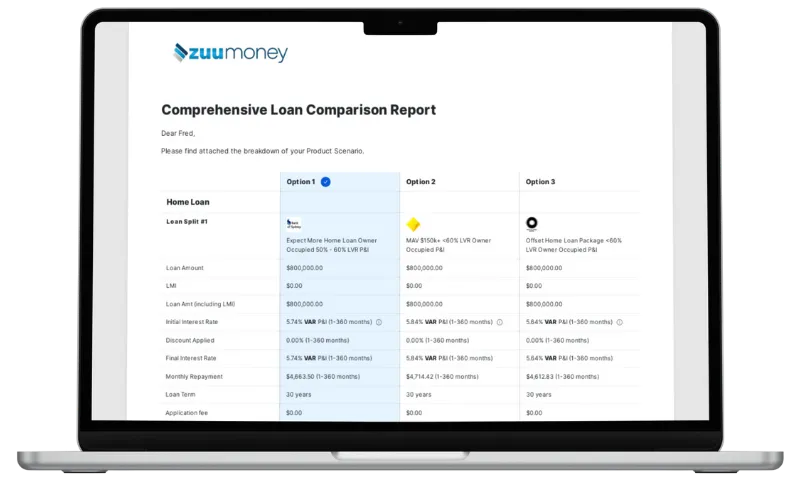
The choice is yours!
We'll compare your loan against hundreds of home loan offers in the market to ensure you're getting the best deal. We'll provide you with a shortlist of suitable loans to meet your budget and lending requirements all from the comfort of your home.
We make refinancing your home loan simple! Start savings by getting started online or talk to one of our home loan experts.
A service worthy of 5 stars


* Discounted rate available for owner occupied on Principal and Interest repayments with minimum loan size >$150,000 with borrowings <70%LVR. Rate subject to change without notice. Lender credit criteria, fees and charges apply. Zuu Money Pty Ltd does not endorse any particular lender. A product will be recommended based on your personal financial situation.
^ Comparison rate is calculated on a loan amount of $150,000 for a term of 25 years based on monthly repayments. Different amounts and terms will result in different comparison rates. Costs such as redraw fees or cost savings such as fee waivers, are not included in the comparison rate but may influence the cost of the loan.
Become a Broker


Zuu Money Pty Ltd ABN 66 670 119 105, Australian Credit Licence Number 567690.
Lender credit criteria, fees and charges apply.
The Zuu Money logo is a registered trademark of Zuu Money Pty Ltd. All rights reserved 2026.