
Different loan types
What type of a loan should I be looking for?

Need help finding a suitable loan?
When you’re looking for a new home you probably have a good idea of what you’re looking for – what it looks like, what size it is, even where it’s located, maybe even right down the street. But when it comes to a loan, where do you start? There are hundreds of loans from a huge choice of lenders. And there are new products coming into the market all the time.
At Zuu Money, our job is to help you find the right loan out of the hundreds available that suit your individual needs. What’s more, we’ll help manage the whole process for you. We’ll assist you with the paperwork and manage the application process right through to approval.
Of course, with all loan products, there are pros and cons, so it’s a good idea to get familiar with the different loan types. Here’s a quick look at the main types of loans and some of their advantages and disadvantages.
Get started online or contact us for help
Variable Loan
Standard variable loans are the most popular home loan in Australia. Interest rates go up or down over the life of the loan depending on the official cash rate set by the Reserve Bank of Australia as well as funding costs and other individual decisions of each lender. Your regular repayments generally pay off both the interest and some of the principal.
You may also be able to choose a basic variable loan, which offers a discounted interest rate but has fewer loan features, such as a redraw facility and repayment flexibility.

Advantage
If interest rates fall, the size of your minimum repayments will too.
Standard variable loans generally allow you to make extra repayments. Even small extra payments can cut the length and cost of your mortgage.
Variable loans often have unlimited redraw meaning you can draw back any additional payments you have made in need.
Typically, variable loans have lower exit costs should you decide to refinance or payout your loan.

Disadvantage
If interest rates rise, the size of your repayments will too.
Increased loan repayments due to rate rises could impact your household budget, so make sure you take potential interest rate hikes into account when working out how much money to borrow.
You need to be disciplined around the redraw facility on a variable loan. If you redraw too often, you will sacrifice gain financial gain you have made and prolong paying your loan.
Fixed Loan
The interest rate is fixed for a certain period, usually the first one to five years of the loan. This means your regular repayments stay the same regardless of changes in interest rates. At the end of the fixed period you can decide whether to fix the rate again, at whatever rate lenders are offering, or move to a variable loan.
Advantage
Your regular repayments are unaffected by increases in interest rates.
Certainty of repayment means you're able to manage your household budget better during the fixed period.
Disadvantage
If interest rates go down, you don’t benefit from the decrease. Your regular repayments stay the same.
You can end up paying more than someone with a variable loan if rates remain higher under your agreed fixed rate for a prolonged period.
There is generally limited opportunity for additional repayments during the fixed rate period.
Fixed rate loans can't be varied (eg. increased) during a fixed rate period.
There may be significant break costs that you must pay if you exit the loan before the end of the fixed rate period. This includes if you sell the property.
Split Loan
Your loan amount is split, so one part is variable, and the other is fixed. You decide on the proportion of variable and fixed. You enjoy some of the flexibility of a variable loan along with some of the certainty of a fixed rate loan.
Advantage
Your regular repayments will be less effected if interest rates increase, making it easier to budget.
If interest rates fall, your regular repayments on the variable portion will too.
You can generally repay the variable part of the loan quicker and access other features like redraw and offset on the variable portion.
Disadvantage
If interest rates rise, your regular repayments on the variable portion will too.
Your additional repayments of the fixed rate portion will be limited.
There may be significant break costs that you must pay if you exit the fixed portion of the loan early, including if you sell the property.
Interest Only Loan
You repay only the interest on the amount borrowed usually for the first one to five years of the loan, although some lenders offer longer terms. Because you’re not paying off the principal, your monthly repayments are lower. At the end of the interest-only period, you begin to pay both principal and interest. These loans are especially popular with investors who plan to pay off the principal when the property is sold. This strategy is usually reliant on the property having achieved capital growth before it is sold.
Advantage
Lower regular repayments during the interest only period.
If it is not a fixed rate loan, there may be flexibility to pay off, and possibly redraw, the principal at your convenience during the interest-only period.
Disadvantage
The overall cost of the loan is likely to be significantly higher.
At the end of the interest only period you have the same level of debt as when you started.
If you’re not able to extend your interest-only period your repayments will increase at the end of the interest-only period.
You could face a sudden increase in regular repayments at the end of the interest-only period.
Line of Credit
You can pay into and withdraw from your home loan every month, so long as you keep up the regular required repayments and do not exceed the loan limit. This type of loan is good for people who want maximum flexibility in their access to funds.
Advantage
You can use your income to help reduce interest charges and pay off your mortgage quicker.
Provides great flexibility for you to access available funds.
Flexibility to make irregular repayments as long as you remain under the loan limit.
Disadvantage
Without proper monitoring and discipline, you won’t pay off the principal and will continue to carry or increase your level of debt.
Line of credit loans usually carry much higher interest rates than a standard variable mortgage.
Introductory or Honeymoon Offers
Originally designed for first-home buyers, but now available more widely, introductory loans offer a discounted interest rate for the first 6 to 12 months, before the rate reverts to the usual variable interest rate.
Advantage
Lower regular repayments for an initial ‘honeymoon’ period.
Disadvantage
Loans may have restrictions, such as no redraw facilities, for the entire length of the loan.
When the honeymoon rate period ends a homeowner may experience an interest rate that is not as competitive as other lender.
Some lenders may charge early termination fees if you decide to switch to a new lender.
Low Doc Home Loans
Popular with self-employed people, these loans require less documentation or proof of income giving greater flexibility to obtain finance. Customers can often access low-doc loans using alternative income evidence such as BAS statements, bank statements and accountant letters.
Advantage
Lower requirement for evidence of income.Lower regular repayments for an initial ‘honeymoon’ period.
Disadvantage
You will pay a higher interest rate than a comparable full doc loan due to the perceived higher risk to the lender.
Low doc loans often require a minimum 20% deposit.
Low doc loans aften have larger application fees and ongoing service fees.
Hundreds of loans from Australia's top lenders
You don't need to run from bank-to-bank to find the best deal. Our team of mortgage specialist will compare hundreds of loans from Australia's top lenders and present you with a range of options that suit your lending needs.













Featured Product
6.09%
PER ANNUM
Variable*
6.11%
PER ANNUM
Comparison Rate^
Or up to
$3,000
Cash Back
A fully flexible, fee free home loan!
Variable rates offer great flexibility with unlimited extra repayments and free online redraw. Contact Zuu Money today to see if a variable rate home loan is right for you.
The choice is yours!
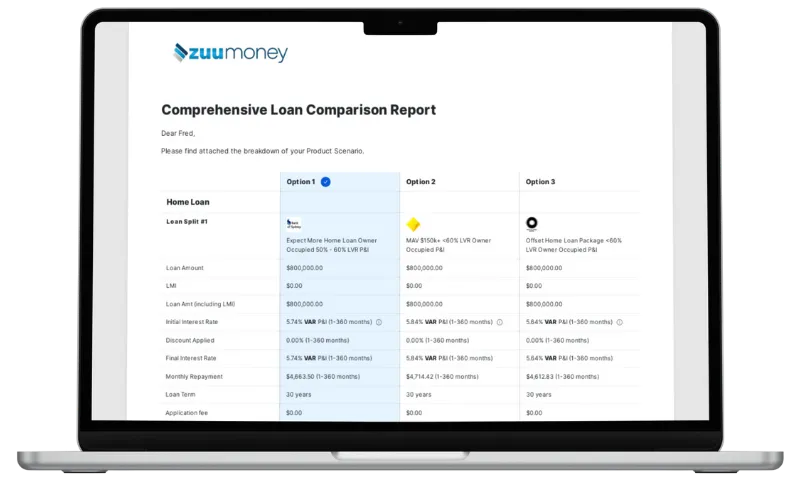
We'll compare your loan against hundreds of home loan offers in the market to ensure you're getting the best deal. We'll provide you with a shortlist of suitable loans to meet your budget and lending requirements all from the comfort of your home.
We make refinancing your home loan simple! Start savings by getting started online or talk to one of our home loan experts.
A service worthy of 5 stars


* Discounted rate available for owner occupied on Principal and Interest repayments with minimum loan size >$150,000 with borrowings <70%LVR. Rate subject to change without notice. Lender credit criteria, fees and charges apply. Zuu Money Pty Ltd does not endorse any particular lender. A product will be recommended based on your personal financial situation.
^ Comparison rate is calculated on a loan amount of $150,000 for a term of 25 years based on monthly repayments. Different amounts and terms will result in different comparison rates. Costs such as redraw fees or cost savings such as fee waivers, are not included in the comparison rate but may influence the cost of the loan.
Become a Broker


Zuu Money Pty Ltd ABN 66 670 119 105, Australian Credit Licence Number 567690.
Lender credit criteria, fees and charges apply.
The Zuu Money logo is a registered trademark of Zuu Money Pty Ltd. All rights reserved 2026.