
Property investment loans
Invest in your future

Start by getting the right advice
Nothing is more financially rewarding than investing in property, however it pays to do your homework before you dive in. Property in Australia is considered a sound investment due to high demand for rentals and a steady and consistent capital gain increase over time.
But it’s not a quick win. Property usually has a seven-to-ten-year cycle, with highs, lows and steady stints in between.
Fortunately, an ongoing housing shortage in Australia and a tax system that allows negative gearing on property (where any investment losses can be claimed as tax deductions) continue to favour housing as a solid, long-term investment.
The team at Zuu Money are property investors ourselves and are here to help find the right lender and loan for your circumstances. We'll sort through the many investment loan options on offer and provide you with the right solution to suit your needs.
Get started online or contact us if you have any queries regarding your investment journey.
Get started online or contact us for help
Featured Product
6.09%
PER ANNUM
Variable*
6.11%
PER ANNUM
Comparison Rate^
Or up to
$3,000
Cash Back
A fully flexible, fee free home loan!
Variable rates offer great flexibility with unlimited extra repayments and free online redraw. Contact Zuu Money today to see if a variable rate home loan is right for you.
Finding and managing your investment

Unit or house
Capital gain over time on houses will often outstrip units. This is mainly due to a concept known as "scarcity". Buying a home means you're also buying the land that the home is built on. Typically land increases in value over time as it's limited, therefore scare and in higher demand as the population grows. Units on the other hand can be built in large volumes on relatively small blocks of land. This makes units less scare as more units can be built to keep up with demand.
An investment house however generally does come with more maintenance cost whilst a unit often comes with additional body corporate fees and strata levies.

Location location
Of course, you’ve heard this before. But location can mean different things when it comes to rental properties. Renters are often looking for maximum convenience so consider properties near schools, major shopping centres and public transport. Also, these properties will generally produce a better long term capital gain.
Spend plenty of time researching target areas, including recent property price movements and future predictions, rental vacancy rates and any proposed infrastructure improvements. It's always a good idea to visit a number of properties on the market and do some comparisons before making a decision.

Remove the emotion
One of the worst mistakes you can make with any investment is to buy with your heart instead of your head. Remember, your rental property is not your ‘home sweet home’.
A well-presented property is desirable, but think sensible, not swank.
Ideally, you want a neutral interior colour scheme, serviceable and resilient flooring and window coverings, a low-maintenance yard and good storage. And if buying an older style unit, look for one with an internal laundry, a garage or car space and few stairs (unless there’s a great view to be had higher up, which can add to the property value).

Don't forget the extras
An investment property requires regular financial commitment beyond the loan repayments. Make sure you have the capacity to cover land and water rates and any maintenance and repair costs. Tenants are entitled to repairs or replacements as quickly as possible under their rental agreement, so you will need to have the capacity to undertake maintenance.
Apartments or units also come with body corporate fees, which can run to thousands in some modern complexes with professional landscaping and shared amenities, such as swimming pools.

Cover your investment
Make sure you take out landlord protection insurance. This will cover you for damage caused by a tenant and unpaid rent if a tenant skips out, in addition to other standard risks, such as a house fire or storm.
If you invest in a strata title property, make sure the body corporate has sufficient building insurance to cover the cost of rebuilding the complex in today’s prices. It’s often hard to work out what you need to cover versus what the body corporate covers. A good rule of thumb is everything from the wall paint inward is yours and everything outside of that is covered by the body corporate.

Principal & Interest? or Interest Only
Many property investors take advantage of interest-only loans because interest payments are a lower ongoing commitment than principal and interest repayment. You are however taking a punt that the property’s value will increase over time, leaving you with a capital gain in the long run.
A principal and interest loan will require you to sustain higher regular payments however your will be paying down your loan over the longer term and will likely receive a lower interest rate.

Managing your investment
Managing a property takes time and energy. We advise getting a professional property manager to advertise your rental, screen and select tenants, collect the rent, co-ordinate repairs and maintenance, provide condition reports and manage any disputes. Ask other local landlords for referrals for reputable managers.
If you decide to self-manage, you will need to be well-versed on tenancy laws and prepared to organise repairs, including those that arise after hours.

Appreciate depreciation
The ATO will give you a discount off your tax bill for wear and tear on property. It’s known as depreciation, and can be a very handy windfall for investors, especially if you buy a new property.
The formula is quite complex and depends on the age of your property, building materials and the various fittings. That’s where a professional quantity surveyor comes in. For a fee (often around $1000), they’ll assess the property and complete a Tax Depreciation Schedule, which your accountant will incorporate in your tax return.

Our top tips for investors
Before you start looking for property it's best to get your investment loan pre-approval in place. This will set your buying limit and make shopping for an investment property more straight forward.
Don't be tempted to choose an investment property purely on its rental return alone. Although rental income does assist with making your regular repayments often it's the capital gain on the property that delivers the real financial benefit.
If you are considering a strata property as an investment remember to pay close attention to the ongoing body corporate fees. These regular fees are often relatively high and will affect your borrowing capacity.
Our suggestion is to never cross securitise your properties, meaning that each loan you have is only secured against a single property in your portfolio. Have a chat with a Zuu Money Finance Specialist about how best to structure your investment loan.
We often get asked is it better to pay down your owner-occupied loan or investment loan first. The interest on your investment loan is generally tax deductible so it makes sense to paydown your owner-occupied loan first. We suggest seeking professional accounting advice regarding your personal financial situation and what works best for you.
Did you know that if you have equity in another property, you can purchase an investment without using any of your hard earned cash savings. This is achieved by drawing equity from your existing property to use as your deposit. Chat with the team from Zuu Money about the correct loan structure to suit your circumstances.
Frequently asked questions

How much can I borrow?
We’re all unique when it comes to our finances and borrowing needs. Your borrowing capacity is determined by your level of income and regular ongoing commitments. Contact us today and we can calculate your borrowing capacity based on your individual circumstances.
How do I choose a loan that’s right for me?
Your Zuu Money Finance Specialist is available to guide you through your lending options based on your individual needs. There are hundreds of different home loans available, so talk to us today about the right solution for you.
How much do I need for a deposit?
Usually between 5% – 10% of the value of a property. Speak with us to discuss your options for a deposit. You may be able to borrow against the equity in your existing home or an investment property.
How much will regular repayments be?
There are many different types of loan products with varying interests which will impact your repayment amount. Talk to us today about the products currently available that suit your lending needs, and we’ll calculate the repayments for you.
How often do I make home loan repayments — weekly, fortnightly or monthly?
Most lenders offer flexible repayment options to suit your pay cycle. Aim for weekly or fortnightly repayments, instead of monthly, as you will make more payments in a year, which will shave dollars and time off your loan.
What fees/costs should I budget for?
There are a number of fees and costs involved when buying a property. To help avoid any surprises, the list below sets out many of the usual costs:
> Stamp duty — This is the big one. All other costs are relatively small by comparison. Stamp duty rates vary between state and territory governments and also depend on the value of the property you buy. You may also have to pay stamp duty on the mortgage itself.
> Legal/conveyancing fees — Generally around $1,250 – $2000, these fees cover all the legal requirements around your property purchase, including title searches.
> Building inspection — This should be carried out by a qualified expert, such as a building inspector, before you purchase the property. Your Contract of Sale should be subject to the building inspection, so if there are any structural problems you have the option to withdraw from the purchase without any significant financial penalties. A building inspection and report can cost up to $1,000, depending on the size of the property.
> Pest inspection — Also to be carried out before purchase to ensure the property is free of problems, such as white ants. Your Contract of Sale should be subject to the pest inspection, so if any unwanted crawlies are found you may have the option to withdraw from the purchase without any significant financial penalties. Allow up to $800 depending on the size of the property.
> Lender costs — Most lenders charge establishment fees to help cover the costs of their own valuation as well as administration fees. We will let you know what your lender charges but allow about $200 to $995.
> Moving costs — Don’t forget to factor in the cost of a removalist if you plan on using one.
> Mortgage Insurance costs — If you borrow more than 80% of the purchase price of the property, you may also need to pay Lender Mortgage Insurance.
> Ongoing costs — You will need to include council and water rates along with regular loan repayments. It is important to also consider building insurance and contents insurance. Your lender will likely require a minimum sum insured for the building to cover the loan.
Hundreds of loans from Australia's top lenders
You don't need to run from bank-to-bank to find the best deal. Our team of mortgage specialist will compare hundreds of loans from Australia's top lenders and present you with a range of options that suit your lending needs.
















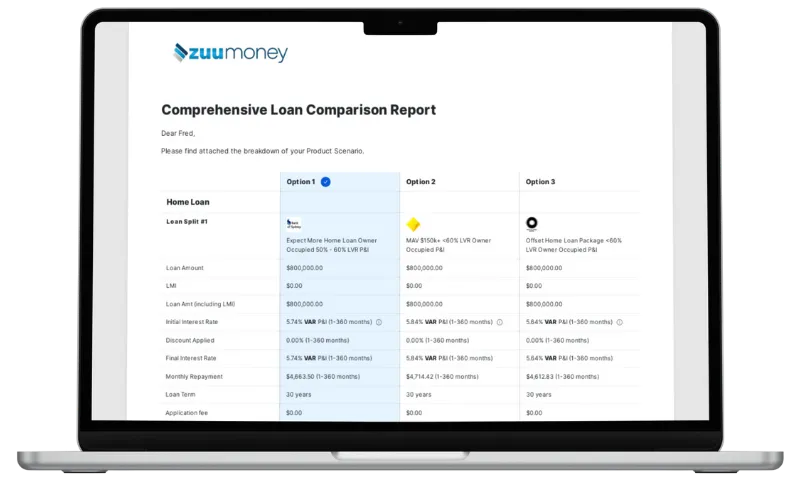
The choice is yours!
We'll compare your loan against hundreds of home loan offers in the market to ensure you're getting the best deal. We'll provide you with a shortlist of suitable loans to meet your budget and lending requirements all from the comfort of your home.
We make refinancing your home loan simple! Start savings by getting started online or talk to one of our home loan experts.
A service worthy of 5 stars


* Discounted rate available for owner occupied on Principal and Interest repayments with minimum loan size >$150,000 with borrowings <70%LVR. Rate subject to change without notice. Lender credit criteria, fees and charges apply. Zuu Money Pty Ltd does not endorse any particular lender. A product will be recommended based on your personal financial situation.
^ Comparison rate is calculated on a loan amount of $150,000 for a term of 25 years based on monthly repayments. Different amounts and terms will result in different comparison rates. Costs such as redraw fees or cost savings such as fee waivers, are not included in the comparison rate but may influence the cost of the loan.
Become a Broker


Zuu Money Pty Ltd ABN 66 670 119 105, Australian Credit Licence Number 567690.
Lender credit criteria, fees and charges apply.
The Zuu Money logo is a registered trademark of Zuu Money Pty Ltd. All rights reserved 2026.